|
Below are links to various maintenance items. The Republic
Service bulletins are here in their entirity. If you see anything (or
have anything) we can add to this page for other Seabee owner's, please
e-mail us
and let us know. We will be glad to add it if we can.
Some files below require Adobe Acrobat Reader®. Get it here! All publications below are to be used at the owner
/ operators own risk. The IRSOC takes no responsibility for the
acuracy of the listed documents. Be sure to check with a licensed
aircraft mechanic (A&P) or the FAA/CAA for the most up-to-date
information.
|
Republic Seabee Parts List -
Original (2.13 MB)
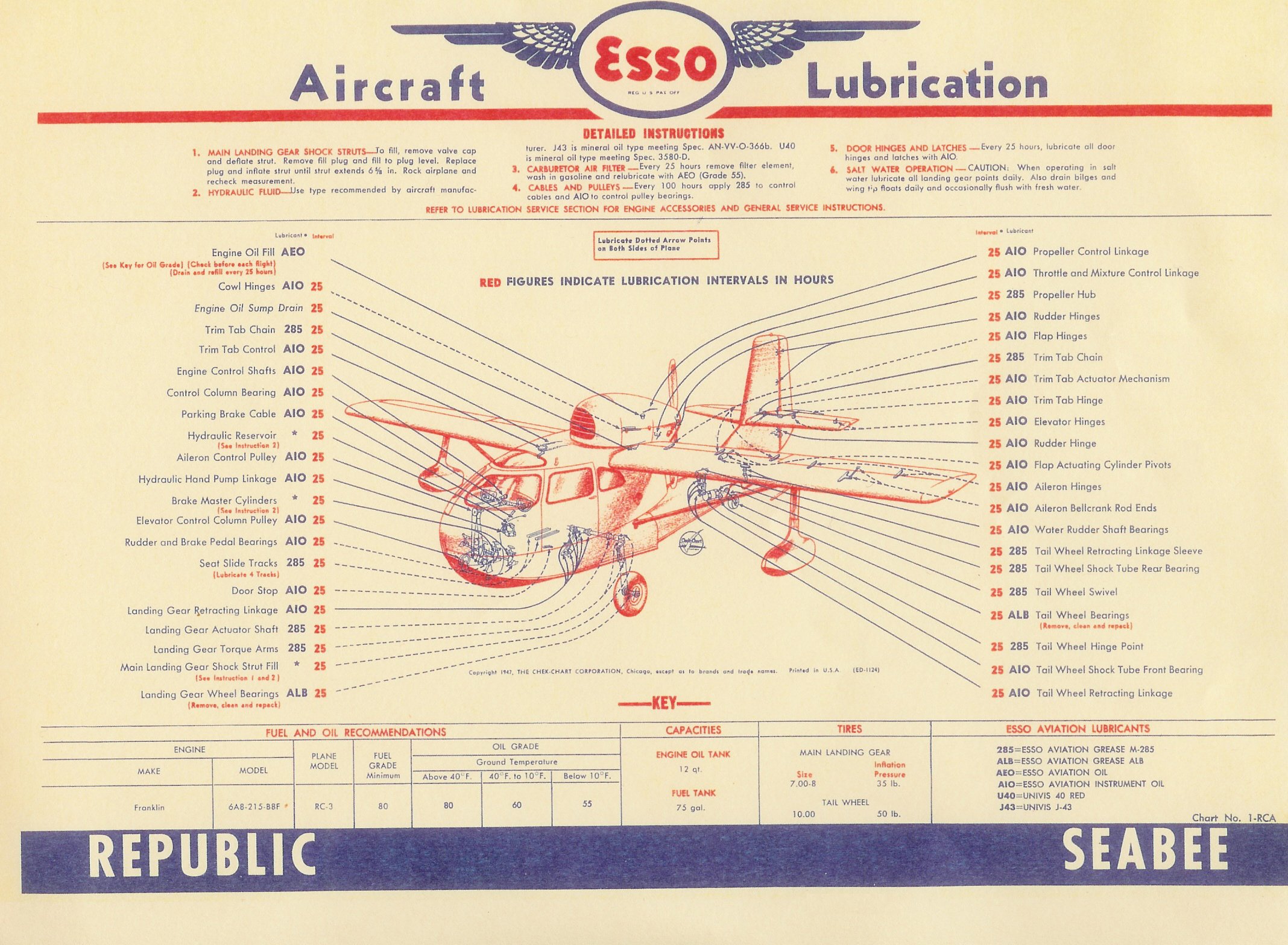
Republic Seabee Lubrication Chart - Published by Esso Oil Co. Circa 1947 (650 KB) or Shell Lube Chart and Shell Lube Receipt. Thanks to Mike Shay and Robert Den Hartog.
Republic Spare Parts Price List - (1947) Reprint of Republic price list. Looks like good prices! Too bad we can't get them now.
Hydraulic Maintenance:
Hydraulic Fluid Replacement - Keeping your hydraulic system clean. Total fluid replacement or just an annual checkup. Thanks to member Bruce Hinds for his editing skills and super suggestions!
Electrol 430 PowerPac Overhaul Procedure - Revised 7-4-2026! 29 pages. Overhaul instructions for Electrol 430 PowerPac. Requires advanced tooling and a steady hand. (5.5 MB)
Electrol Hydraulic Pump Manual - Electrol Incorporated, Kingston, NY (156 KB)
Electrol Hydraulic Powerpac Troubleshooting - Electrol Incorporated, Kingston, NY (300 KB)
Hydraulic Pump Problem Areas - Reprinted form an old newsletter from the 50's or 60's. Updated by yours truly. (21 KB)
Hydraulic Servicing - Reprinted from Aviation Magazine, September 1946 (1.3 MB)
Electrol 430 Hydraulic Pump Plunger Installation - This article explains how to re-install the plungers in the pump body (The hardest part). I can't guarantee results as I haven't tried this yet. The procedure sounds resonable however. (880 KB PDF)
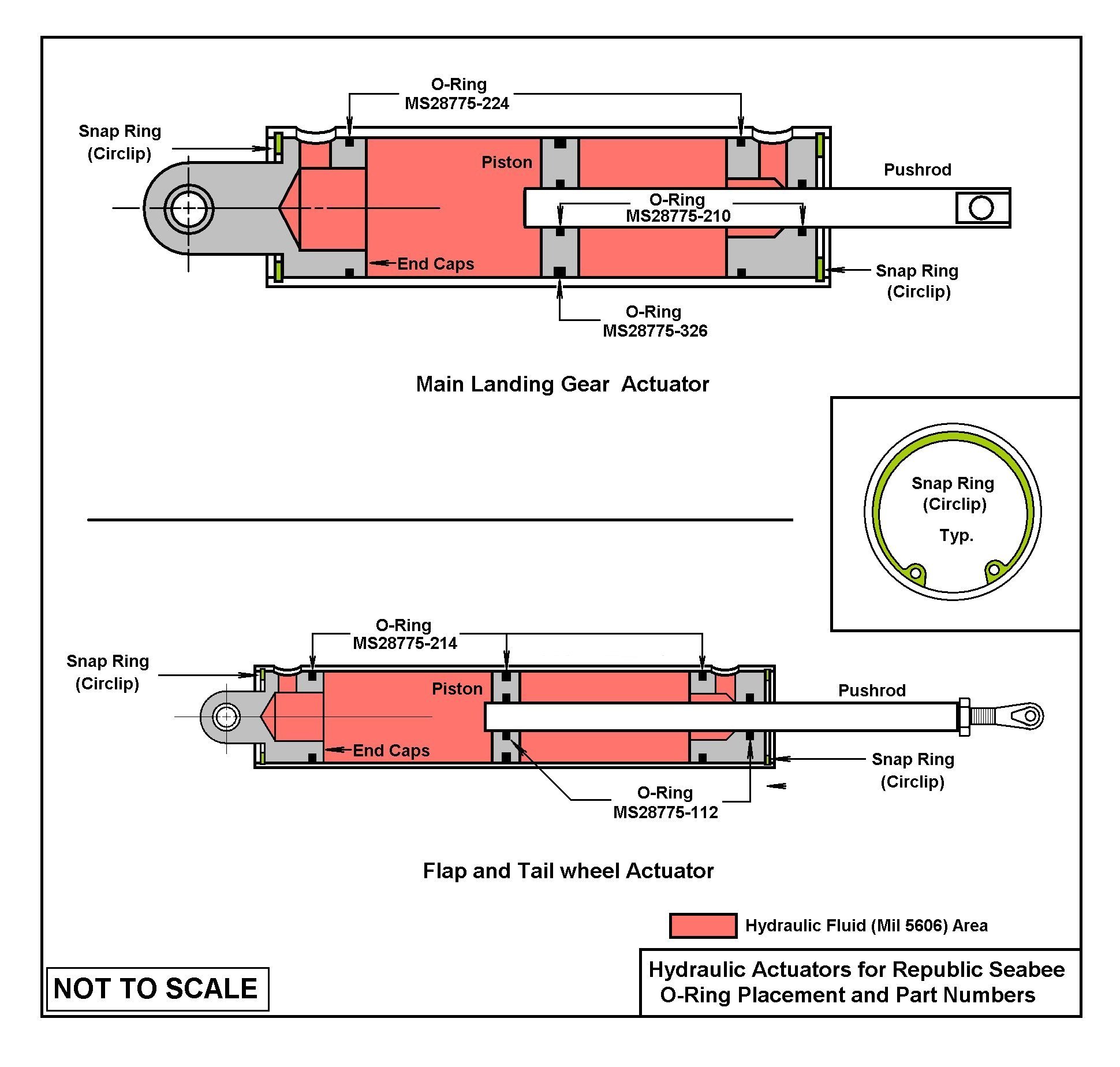
Hydraulic Actuator O-rings - Drawing. If you need a set of o-rings, e-mail me (smestler@pbtcomm.net) or check out the "Stuff for Sale" page. $12.00/kit.
O Ring List - Updated 1-9-2017: Added MS numbers. O-ring AND bearing list by Tim Sutter. I checked most of the numbers and they are right on. Thanks Tim! (Download Old list here)Fuel Cell Refurbishing
- Original document from Republic-? (58 KB)
FAA Approved Type Certificate Data Sheet for RC-3 - Sky Enterprises, Inc. (17 KB)
Seabee Fuel Dipstick Photo - Thanks to member J.R. Ranney. Stick is half round (dowel cut in half long-wise). I would add the RED "No Takeoff" warning up to the 12 gallon mark though.
Seabee Fuel Dipstick measurements - Thanks to the late Dick Sanders from his Seabee Newsletter, Volume 1, Number 6 dated July 1985 (43 KB)
Control Column U-joint - (PDF) Replacement of control column u-joint.
Control Wheel Play - (PDF) Remove any unwanted play in the control column.
Air rudder locks - (PDF) Easy air rudder locks that could save your rudder!
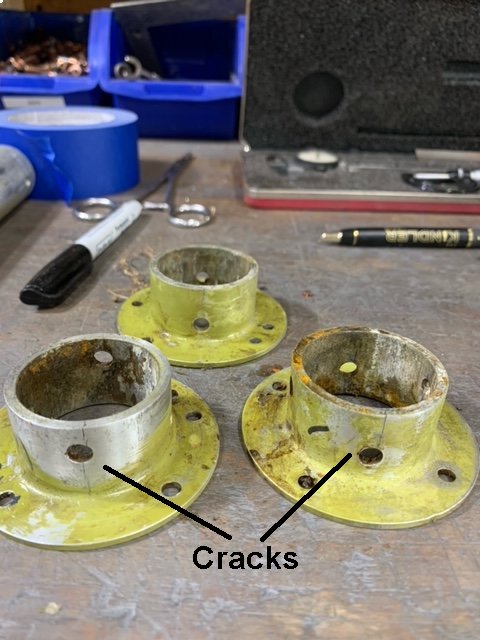
Check your Elevator collars - This has come up before but it's worth repeating. Check
the torque tube collars on the elevator for cracks. They are aluminum
and, evidently, crack with age or with over torqued through bolts.
See photo here
Forward Rudder Pulley Replacement - (PDF) Change the forward 2" pulleys with 3" pulleys to reduce cable wear.
Replacing your Aft Rudder Cables - Updated 4-27-2018. Rev. 4 (PDF) Changing the aft rudder cables. Read these instructions completely BEFORE starting. by Steve Mestler and Bruce Hinds.
Check your Water Rudder Cables - (PDF) An easier way to change your Water Rudder Cables. by Steve Mestler
Check Your Rudder - (PDF) Loose rudder bracket can be fatal! This article exlains how to check for play in the lower rudder cable bracket and how to fix it. Thanks to an "active" Club member for authoring this and to Bruce Hinds for his input.
Seabee
Cable List - (PDF) Thanks to Frank Scully at Beechurst Industries
(136 KB)
Seabee Lubrication chart - Thanks to Mike Shay (NC6157K)
Trim System Rigging and replacement - Updated 6-17-2026 (PDF) by Steve Mestler and Jaren Lynn. Fix, rig or replace your trim system. This shows you how with the help of your favorite A&P.
Check your forward Rudder Cables - (PDF) by Steve Mestler and Bruce Hinds. Check for fraying on forward rudder cables and replacement instructions. Steerable tail wheels especially.
Aileron Bellcrank fix - The pivot holes in your bellcrank may be frozen due to corrosion or lack of lubrication. This fix looks really good! (Tips and Tricks page)
Landing Gear:
Landing Gear Strut Servicing - (PDF) This may clarify the strut servicing procedure.
Tail wheel donuts and spacers - Article by mechanic Ken Dayo explaining how to make your own donuts and aluminum spacers. It works!
Tail Wheel Seal - If your aft compartment is filling with water, this may fix it. Changing part number 1414.
Tail Wheel Microswitch Security - Failure of the microswitch "cage" may cause your tail wheel to NOT come down completely.
Main Gear Fork Failure - (PDF) Make sure your landing gear system is tight! Read a couple of landing gear failure reports.
Part 1112 or How to land with the landing gear not down (or up) - (PDF) A stirring article about a landing gear failure that was a complete success. See video here (MOV-courtesy of Cannon Falls, MN Fire Dept.)
My green gear light is out on the ground! (PDF) - If your green gear light is out and the bulb is good, you may have this problem.
Check your H-Bracket (Republic Part Number 1112) (PDF) - If your landing gear won't lock down, check your H-Bracket under the back seats.
Change your Crosstube Seals (PDF) - If you noticed water getting into your hull under the landing gear or your crosstube seals are cracked, you may need to change these. By Steve Mestler
Change your Tail Wheel Bearings (and Races) (PDF) - This procedure was writen for the Bendix Tail Wheel but may be of use to any tail wheel you have. By Steve Mestler
New bearing Seals for our Seabees (PDF) - Parker Hannifin makes "real" seals for our Seabee wheels. We can now eliminate the felt seals! Please follow the instructions carefully as there are parts of the old system that must be used again. Part numbers: 154-12000 (inner), 154-12400 (Outer)
Fix your leaking strut o-rings - (PDF) Complete strut overhaul procedures by Steve Mestler. Edited by Tim Sutter.
Tail Wheel Donut and Spacer replacement - (PDF) Replacing your shock absorber donuts when the trailing angle just can't be maintained anymore (90-95 dgrees from vertical). This procedure should be done VERY carefully as explained in the replacement instructions. If you need donuts and spacers, click here.
Strut O-rings - (PDF) Drawing of strut details and O-ring numbers. If you need a set (Enough for 2 struts) e-mail me (smestler@pbtcomm.net) The kit includes X-Rings or standard O-rings. $16.00/kit.
Tail Wheel Cable Guard - (PDF) Simple fix for tail wheel cable jamming.
Tail Wheel Quadrant Adjustment - (PDF) Adjustment of the steerable taill wheel locking piston.
Locking Tail Wheel - (PDF) Description and adjustment of the locking tail wheel system. By Bruce Hinds
Tail Wheel Tires - (PDF) An article showing the various tail wheel tires available for our Seabees. Thanks to member Bruce Hinds.
Miscelleneous Information:
Seabee Vents - Or, "What are all these holes on the sides of my Seabee?.
Hull Stands - Make your own hull stands! These are required for any kind of Landing Gear maintenence and retract testing during an Annual Inspection.
Painting your Seabee - Step by step procedure for painting your Seabee or part of it.
Vintage Aircraft Replacement and Maintenance Article (VARMA) - EAA article on what we can replace and how to do it through the FAA.
Seabee Window Replacement - (PDF) Member Joe Thorne has got it goin' on! This article should help you replace those crazed, foggy windows. Thanks Joe!
Wing-Adectomy (or how to open your wing) - Updated 1-12-2020 (PDF) Here is how you open your wing with minimal trouble. Special tools and guidance are required.
Flap Hinge Crack Fix - (PDF) Fix cracks in trailing edge spar flange.
Weighing Your Seabee - How to weigh your Seabee after major weight changes.
Weight and Balance Worksheet - Excel spreadsheet to determine your Weight and CG location prior to flight.
"Unofficial" Seabee Specifications - List of parts, seals, dimensions and notes for our Seabees. No guarantee that it is accurate.
Aging Aircraft Practices - Good for keeping our Seabee's young! September 2003-Endorsed by the AOPA, EAA, AAA and FAA (424 KB)
Heater Information:
If you have a heater in your Seabee, you need to read this! NPRM (read
AD) to be issued by the FAA that may require heaters to be inspected
and/or replaced. (Sounds expensive!)
Click here. Thanks to member Bruce Hinds for letting us know. Update! See AD 2017-06-03 below.
AD's,
STC's, AMOC's, FAA 337's and Seabee Manuals!
Airworthiness Directives - Airframe (FAA)
Airworthiness Directives - Engines, Propeller and Appliances (FAA)
Buy your Manuals! Essco Aircraft Manuals and Supplies
Manuals on DVD and USB ! Check it out here (by
Steve
Mestler)
Get all known
records (STC's, etc.) for your airplane from
the FAA! $10.00 per airplane on CD! Paper records available as well. Various charges apply.
Known Seabee
STC's or Search
for an STC
All known 337
forms for the Republic Seabee - UPDATED! Click
here!

|
(Ed. Note: This e-mail was received by the
Seabee Yahoo newsgroup and I felt it was important enough to post here.
Please check your linkages! Steve for the IRSOC)
"The clevis on the gear piston
doesn't last forever. Check your clevis (mine was original). Not only
does your gear not operate, it punches a jagged hole in the rear
bulkhead about ½".
Guess what happens next? Yes,
you guessed it. A hole wears into your fuel cell in approximately 2
years. This is the fourth time I have heard of this. I'm sure there
have been many more, just not
reported.Note: I'm not talking about over center lock. Make a note, for those who need
gear box work, on Lyc 480's try Jaars in North Carolina
(704) 843-6300. (Paul or Tim) cost approx. $1200.00? George Papich |
|
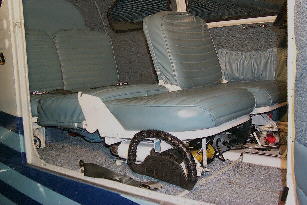
JIM POEL'S ALUMINUM RECLINING SEATS Here is a picture of my new seats. The
recline position is achieved by moving the front seat all the way
forward, reaching behind the front seat back and squeezing 2 pins that
retract the 5/16 rods that sit in the hooked frame. It's hard
to picture.
The good news about these
seats is that they are aluminum, not steel, saving over 11 pounds of
weight. I also had my back cushions reduced from 4" deep to 1" deep.
This allows more leg room and saves another 5 lbs. The seats are
Republic parts and the pin mechanism change was Jim's idea.
(I don't have a copy of Jim's modification. If you do, please send it to me so I can post it on the website. Thanks. SM - for the Seabee Club) |
|
HENRY RUZAKOWSKI ON FRANKLIN SOLUTIONS, ETC.
I am not a big proponent of the Franklin engine, that is why, 20
years ago, along with my father at the time we did the first of the
Daubenspeck conversions using the Lycoming GO-480 engine. In 1982 we
did the Simuflight conversion on our Seabee and have been happy ever
since. But, back to the Franklin engine. Richie Brumm is the gentleman
who is rebuilding the Franklin's out in Long Island, NY. Richie is a
personal friend of mine and has spent many many years working on the
problems of the Franklin engine.
A few years ago, he
assembled the first of his engines and as of this past summer, has
turned over 1000 hours of continuous operation on his Franklin engine.
At present, he has 12 engines in the shop being overhauled at this
time. There are a couple of his engines out there, of which I have
flown one of them. I was completely surprised as to the quietness of
the engine.We took of the headsets after takeoff and it was remarkable
at the lack of engine noise, and for the record, I was flying in the
loudest (Lack of insulation) of Seabees with Riches engine. The
performance was better than I had expected and it actually wanted to
fly before I was ready, and had to pull the stick back to start the
climb. It did get my attention.
Now, by no means is
it a Super Bee, you load it down and it will be a water lover for a
while again, but I'd be willing to bet that it is putting out close to
the 215 HP it was supposed to. The modifications are extensive, but you
have a product that is (and I hate to say it) reliable.
I fly only Super Bee's, and
a Seabee with Richies engine is an exception to my rule, I'd have no
second thoughts flying one of his engines. And a
gross weight increase on the Franklin, well, we don't even want to go
there. But for the record, a Seabee with the Franklin will more than
likely have a higher useful load than a converted Seabee, this is due
to the aft CG of the basic installation and the addition of ballast,
and in a Super Bee you generally
put quite a bit of "toys" in the aircraft. You should see some
of the mods that Ken Thompson puts in on his Seabees for owners,
and I am still waiting for him to install the kitchen sink yet...
|
|
Question: PROPELLOR CAVEAT Bill Krause writes "John, what is the propellor on a Seabee made from? Is it wood covered with plastic or some kind of composite?" Answer:
HENRY (Mr.Seabee) RUZAKOWSKI ANSWERS "Bill,
The original Seabee prop was made of Micarta. Kind of like today's
Phenolic. You did not mention the stainless steel leading edge that was
flush riveted to the prop. I do not believe that this prop is legal
today. I do know of one flying three or four years ago. I know I
wouldn't get into a Seabee with one on it. It had a bad record of
slinging blades, this happened on more than one
occasion.
Bebe Rebozo
(Pres. Nixon's Florida banker) had a Seabee with that prop on
it and could not pass the annual inspection, so he borrowed a
three-bladed prop from a friend and got the Bee annualled. As expected,
he swapped back to the old prop. A couple of
months later he "threw" a blade and crashed in Biscayne Bay
near the Nixon Compound. He spent the next eight months in the hospital.
MORAL: It is a great prop to hang on your wall, as
my father did, in his home in the Keys." |

|
LEAKY MAIN GEAR STRUTS? Contact Bruce Hinds at brewster@wavecable.com.
He tells of success sealing with Green Leaf Seals and an additive used
by Convair. Worth looking into.
|
|
STC FOR SEABEE ENGINE CONVERSION Bruce Hinds writes: "I
believe the STC for the conversion to the Lycoming IO-540 (300 HP)
is held by Randy Komko A/P of Yelm, Wa.
TEL: (360) 458-7715 Mobile Tel: (253)
229-7219 |
|
HARTZELL PROP PROBLEM Date: Fri, 26 Mar 1999 18:34:06 John, Doug Kenair |
|
Another HARTZELL PROP PROBLEM...
(Ed note: I received these e-mails a few months back and felt it was important enough to post as others may find this information useful. Check your reverse mechanism including the return spring especially on the Franklin / Hartzell combination. Capt. Dick Saunders mentions this spring MANY times in his newsletters. Check them here!) George Papich wrote: "I have had periodic problems with what I thought was my Hartzell propeller this year. It worked wonderfully on climb, but my $26K prop would go crazy when going to cruise. It fluctuated between climb and cruise during level flight making the ride exciting to say the least. I
talked to both Hartzell and Seabee gurus to no avail. Their thoughts
ranged from adjustments, the governor troubles, fuel injection, and
carbon block problems.
At
the Clear Lake fly-in Sept 2003, the problem reared its ugly head once
again. Fortunately an old friend, Randy Komko, was there with one of
his beautiful new 350HP Lycoming conversions.
Long story short, Randy looked at all adjustments. At first everything was perfect. Then he made me get into the plane and work the controls. During the run through he asked me to try the reverse again. I hadn't even touched those controls and told him so. Interesting. The reverse lockout was moving about 1/4 inch. The lockout hole was elongated about 1/8 inch in forward and 1/8 inch back. This is not located at the reverse control but back in the cabin reverse lever. Over the years the lockout hole had worn out .040 of the aluminum lockout pin. I
now have a steel insert with a new machine pin. It has zero movement.
In retrospect, the propeller worked perfectly as Randy explained. What was happening was the governor was shutting down. The Hartzel prop was saving my bacon. Instead of going to reverse or cruise, the prop was saying by itself to go back to a much safer climb pitch. I have from Randy, a copy of Hartzell propeller operation and adjustments. If anyone has a SeaBee, you should have this information. (I'll forward on a copy if you'd like it). I've asked Randy and you can also contact him at Transition Aircraft:"
George
- I had a similar problem when we started flying our bee last year
after a
restoration. The bracket that secures the reverse cable to the
prop housing was too short and would not allow the reverse control
valve to come all the way out of reverse. No serious incidents
but we felt very fortunate when found the problem. Thanks
for sharing your story...
Bill Shaver
Huntsville,
Alabama
N6072K.
|
Back
to Top
Updated October 23, 2026 (Moved Tail WHeel tires to "Landing Gear section, Added Seabee Vents, Added Strut Servicing, Added
Spark Plug article, Added NEW GO-480 Operating Manual)